AGOS
Contact

The agentic operating system for investment management.

Connect institutional knowledge, financial models, and operating systems so agents can investigate, calculate, and act.

Use Agos applications or build on the platform through SDKs, APIs, and MCP.

Platform capabilities

  1. EvidencePrism

    Process documents, retrieve supporting records, and trace findings back to their sources.

    Input
    A lender term sheet, a rent roll, and the seller’s operating statements for one acquisition.
    Output
    Extracted terms and findings, each linked to its page and passage. Fields without support stay marked as gaps.
    Works with
    Document stores, data rooms, and mail attachments.
  2. Context and memoryPlexus

    Carry institutional knowledge, relationships, and prior decisions into each new task.

    Input
    A new task: prepare the quarterly review for one asset.
    Output
    The asset’s relationships, prior decisions, and open questions from earlier work, limited to what this task is permitted to see.
    Works with
    CRM records, prior cases, and relationship history.
  3. ComputationManifold

    Execute financial models, inspect calculation traces, and compare scenarios and portfolio consequences.

    Input
    A revised vacancy assumption, declared against the firm’s agreed model.
    Output
    Recomputed statements, the calculation trace, and the change in returns against the accepted case.
    Works with
    Institutional models and Excel workbooks.
  4. CoordinationEnsemble

    Maintain work across agent runs, with shared tasks, handoffs, and human review.

    Input
    An investigation split into research, modeling, and a draft response.
    Output
    Shared tasks with owners and handoffs, status carried across runs, and a named reviewer before a change is accepted.
    Works with
    Agent hosts, task systems, and the firm’s reviewers.
  5. CommunicationRelay

    Connect conversations, drafts, delivery, and replies to decisions and actions.

    Input
    A lender question received by email.
    Output
    A draft reply citing the evidence and model result, approval where the firm requires it, a delivery receipt, and the later reply filed with the work.
    Works with
    Email, calendars, and team messaging.
  6. MonitoringOrbit

    Connect changing conditions to investigation, follow-up, and assessment of results.

    Input
    A condition to watch: occupancy against the business plan.
    Output
    Dated observations compared with the plan, an investigation opened when the condition changes, and results assessed as new reports arrive.
    Works with
    Operating statements, property systems, and scheduled reports.

Use the capabilities your workflow needs. Authoring and Agos Office bring analysis into documents, spreadsheets, and Excel, Word, and Outlook add-ins.

Applications

Investment applications built on Agos.

Reia

Real-estate underwriting.

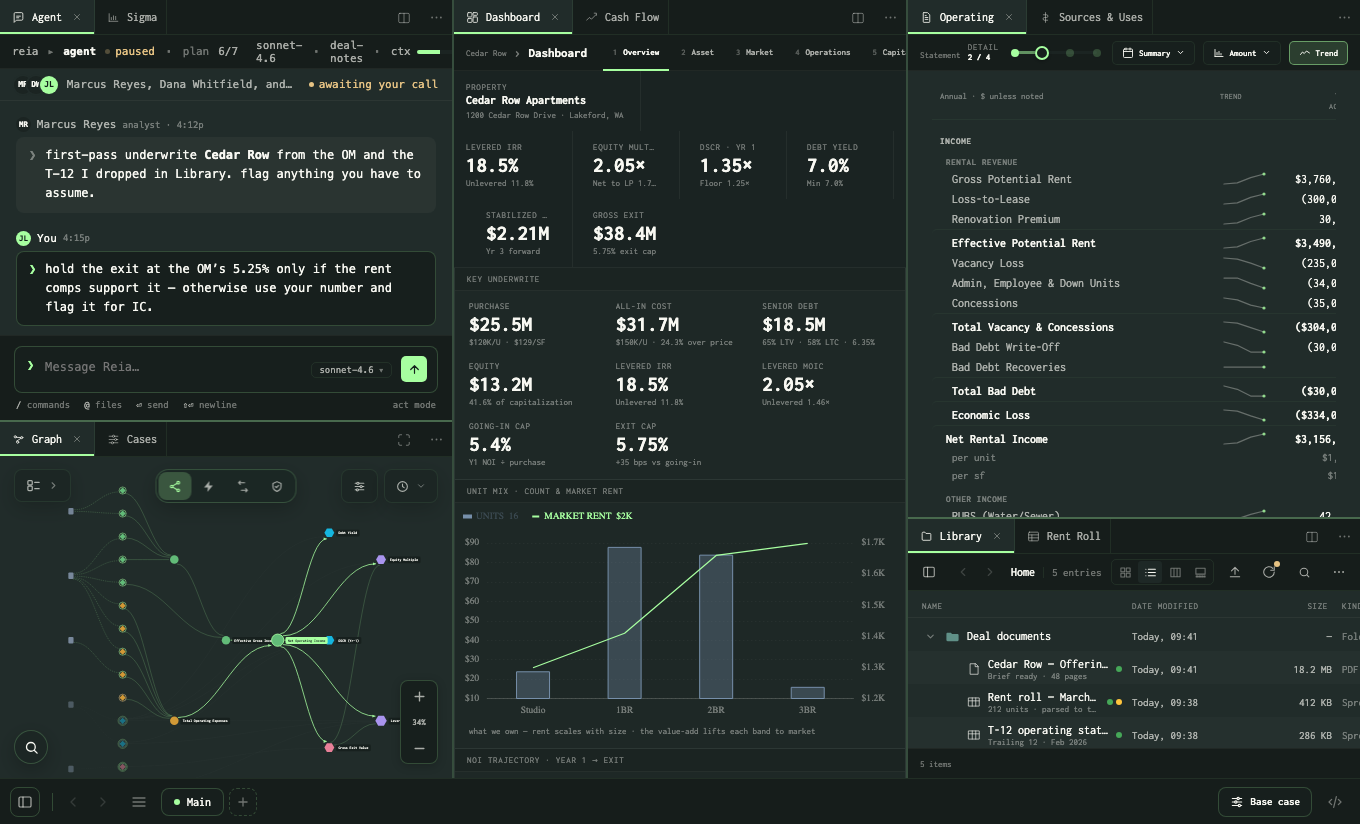
Investigate a deal, review its assumptions, and see how changes affect the underwriting. Sources, calculations, questions, and reviewed changes stay attached to the deal.

Reia · Cedar Row
Reia
Reia underwriting workspace — Cedar Row synthetic case with Agent, graph, dashboard, operating statement, and library
Reia underwriting workspace · Cedar Row synthetic case.

Veia

Venture underwriting.

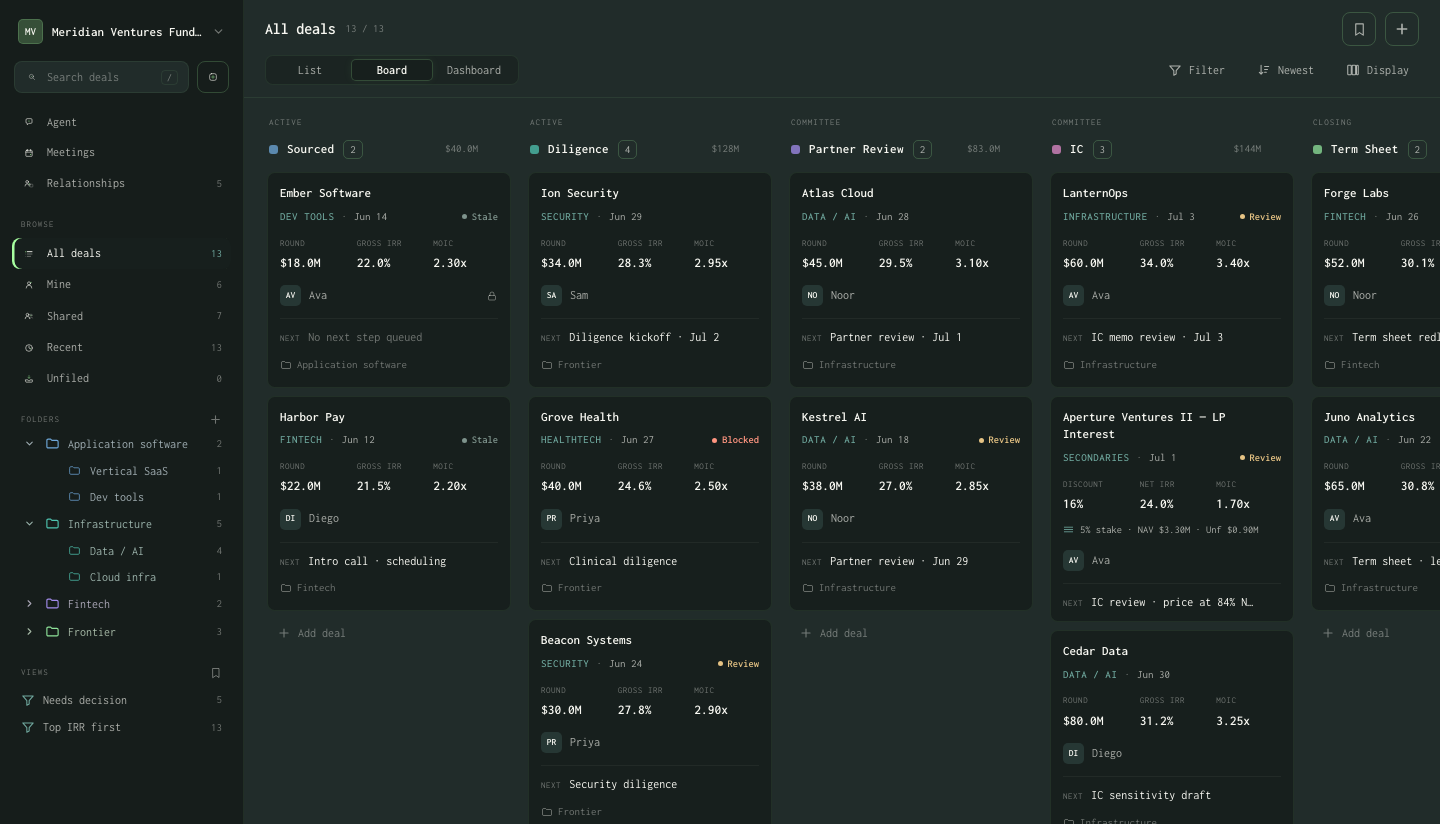
Connect company evidence, investment alternatives, and fund consequences. Compare follow-on decisions with their assumptions and financial results in view.

Veia · Portfolio
Veia
Veia portfolio board — companies organized by stage, status, owner, and next action in a synthetic fund
Veia portfolio board · Synthetic fund.
Example workflow

Carry the investment plan into operations.

Operating costs exceed the plan. Inspect the variance and its supporting records, compare a revised forecast, and prepare a response with an owner and deadline. Follow up on progress, then assess the financial result as new reports arrive.

The evidence, calculation, response, and later observations stay with the investigation. Task completion and financial improvement remain distinct.

  1. Accepted plan · quarterly reporting
    Condition
    Q3 controllable operating expenses: $412k actual against $361k in the accepted plan.
    Calculation
    $412k − $361k = $51k over plan (+14.1%).
    Record
    Q3 operating statement, controllable expense lines.
  2. Supporting records
    Repairs ledger
    Q3 repairs and maintenance: $38k of the variance.
    Invoices
    Three emergency HVAC invoices, August–September: $31k of that $38k.
    Prior decision
    HVAC service contract renewed in March at prior-year terms, without preventive maintenance.
    Remainder
    $13k across utilities; no response proposed.
  3. Scenarios · not accepted
    Assumption
    Q1 and Q2 actuals are assumed equal to plan, $361k each. The forecasts change if they did not.
    Accepted plan
    Full year $1,444k = 4 × $361k
    If one-time
    Q4 returns to plan: $361k + $361k + $412k + $361k = $1,495k, +$51k.
    If recurring
    Q4 repeats Q3: $361k + $361k + $412k + $412k = $1,546k, +$102k.
    Plan
    Unchanged.
  4. Proposed response
    Proposal
    Rebid the HVAC service contract with preventive maintenance included.
    Approval
    Asset manager approved the rebid on October 6.
  5. Execution · weekly follow-up
    Owner
    Property manager, with a deadline of November 14.
    Delivery
    Request for proposals sent to three vendors on October 8 from the approved scope; delivery receipts kept with the task.
    Follow-up
    Weekly until the rebid closes.
  6. Task complete
    Completion
    Contract awarded November 12, before the deadline.
    Result
    Cost impact pending.
  7. Observed result · quarterly reporting
    Observation
    Q4 statement: $379k against $361k planned.
    Calculation
    $379k − $361k = $18k over plan, down from $51k in Q3.
    Attribution
    Variance narrowed; contribution of the rebid remains unverified.
    Next
    Checked again when the Q1 statement arrives.

Example workflow with synthetic figures. Illustrative composition, not a customer result or a product capture.

Build

Build on Agos.

Retrieve evidence, execute models, inspect results, and integrate shared work through typed Python and TypeScript clients, REST APIs, and MCP tools. Your team controls data access, permitted actions, and review requirements.

Python SDK
agos

Analytical jobs, data pipelines, and backend services using typed requests and structured results.

TypeScript SDK
@agos/sdk

Applications and services, with optional React components for supported interactions.

REST API

Other languages and workflow systems calling authenticated operations.

MCP tools

Agent hosts using a selected set of Agos tools within the caller’s permitted scope.

The developer platform is in private preview. We agree the operations, integrations, and deployment for your workflow, including a licensed installation in your cloud where required. Agos maintains the platform and provides integration engineering. Each institution retains control of its data and institutional knowledge.